StarVeil
Space texture synth
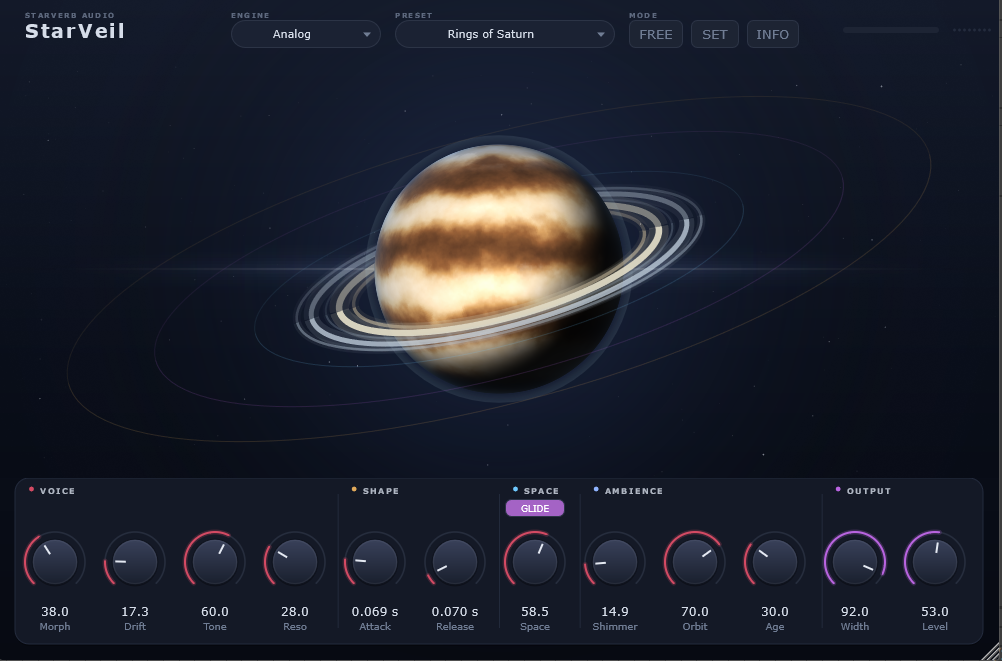
What it does
Morph
The knob that matters. It crosses the two poles of the chosen engine, from the vintage one to the future one — and the interesting part is the middle, where both live at once.
Twelve engines
Analog, Pulsar, Crystal, Choir, String, Plasma and Telemetry, plus five organs: Tonewheel, Pipe, Theatre, Combo and Reed. Each one changes both ends of the Morph sweep.
Shimmer reverb
An 8×8 feedback network whose tail re-enters an octave above itself. Each pass stacks on the last, so the cloud keeps climbing instead of fading flat.
Ensemble and tape
A BBD ensemble for the wide chorus of old string machines, and Age for tape wow, flutter, soft saturation and hiss.
45 presets
From a quiet pad to a cloud that never ends. A preset sets the engine too, so picking one changes the sound completely — unless Free mode is on, which keeps your engine and takes only the knobs.
Wheels that just work
Pitch bend of ±2 semitones and vibrato on the mod wheel, on every engine — including String and Plasma, where the pitch doesn't come from an oscillator at all.
StarVeil isn’t an effect, it’s a generator. You play it from a MIDI keyboard and it makes pads, drones and tails that sound like they come from a long way off.
The idea is to hold together two eras that usually live in two different machines: the detuned unison of 70s analogue synths and the crystalline FM of 80s digital ones, with Morph crossing from one to the other.
String has no oscillators at all — it’s a physical model, an actual string vibrating, and there Morph changes how it’s set in motion, from a sharp pluck to a continuous bow. Plasma has none either: the pitch comes out of two very narrow resonances inside noise, like wind through a gap.